This article was written by the hunger-striking comrade Aristotelis Xantzis. We release this translation on his 36th day of indefinite hunger strike to death in defense of life to prevent the eviction of the Community of Squatted Prosfygika.
Original article:
https://tvxs.gr/apopseis/arthra-gnomis/prosfygika-o-apergos-peinas-grafei-sto-tvxs-gia-tis-fotografies-ton-200-tis-kaisarianis/
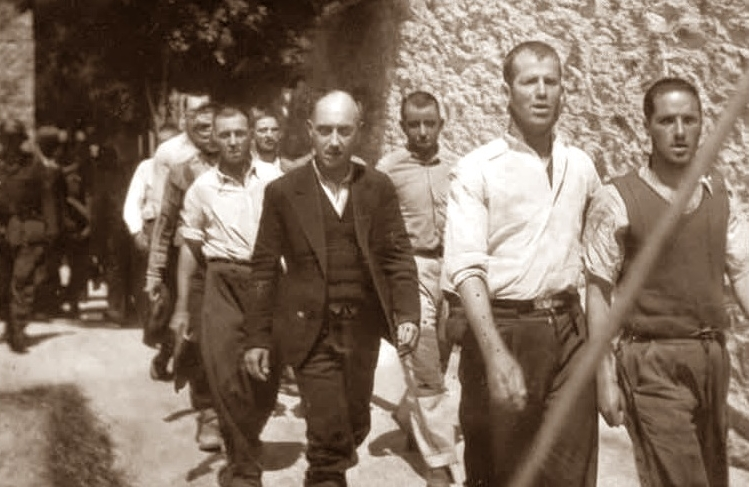
The photographs of the 200 executed men of Kaisariani on May Day 1944 emerge perhaps at the most appropriate moment, as we are reminded that those who took the path of resistance did not think of the cost and looked death in the face with a raised fist. After 84 years [sic], they are a breath of life, a source of inspiration and struggle for the new generations.
In these photographs it is not only these unyielding fighters who are depicted, but sketched in their implacability is all of the resistance to the brutality of the Haydari, Merlin, and Akronafplia camps, as well as of so many other hells.
Every one of the 200, just like so many still-“unknown soldiers” —because they were, are, and will be the true unknown soldiers who gave their lives against the occupiers— had a name, a story, ideals. They were workers, trade-unionists, members of the KKE [Communist Party of Greece], Trotskyists, Archeio-Marxists. The majority of them were handed over from the Metaxas regime to the occupying powers, having been condemned under Venizelos’s Idionymon1, which was maintained and reinforced by Metaxas by replacing it with the so-called “emergency law”.
The declaration of these historic photographs to be a “monument” is not simple hypocrisy of the Ministry of Culture, but rather shows the meaning that the current government ascribes to “monuments”. For the government which gives land water and land to American interests and to the oligarchs, which prepares the modern Akronafplia camps in the form of eight new prisons, which is to blame for the deaths of hundreds of refugees and immigrants, which threatens independent journalism, which paves the way for new Idionyma with anti-communist korones2, “monument” means distortion of the history of the resistance.
For the government of the New Penal Code, of the executive state, of PREDATOR3, of OPEKEPE4, of Tempi,5 of the extreme repression, which gave the Byzantine Museum to the Glücksberg family for a dinner party; for the government of the vile shamelessness which grips the ruling class, “monument” means oblivion in the historical memory.
For the government of the political progeny of the Nazi collaborators and of the Tagmata Asfaleias6, is it possible to respect this historical memory?
Today, the same government is trying to constrain the Community of Squatted Prosfygika of Alexandras Avenue, with the pretext of the creation of social housing and hosting structures for companions of the Agios Savvas cancer hospital. The Prosfygika buildings on Alexandras Ave., a remaining monument of contemporary history because of the marks of bullets and mortar shells from the battles of the Dekemvriana7, are threatened to be plundered in the name of gentrification of the broader Ampelokipoi area. Along with them, the plunder of historical memory as well as the continuity of the resistance.
But what is the Community of Squatted Prosfygika? What does it represent? Why is it such a great danger for the Mitsotakis government? What are the stakes?
In these 16 years of its operation, the Community of Prosfygika has reinforced the participation of individuals in shared issues through direct-democratic processes in regular assemblies, plenary conferences, and a plethora of social solidarity structures. Structures for housing, for food, for health, for education and childcare. Structures for hosting cancer patients who are hospitalized at the Agios Savvas cancer hospital along with their companions. Structures for women’s empowerment, culture, art, technical support for occupants, and many others.
Just as in the period of the occupation, until the end of the Dekemvriana, the “National Solidarity” organization was the one that organized bread lines, built daycares, pharmacies, clinics, hospitals, and houses, while the political ancestors of the contemporary elite lined up with the [Axis] occupiers; so today, the structures that suffer the most severe criminalization and repression are those which really try to solve the social problems that the elite has created.
Just as after the Dekemvriana they closed and demolished with explosives the offices of “National Solidarity”, arrested and imprisoned its officials, destroyed and looted its structures; so today in the same way they make attempts at the social solidarity structures. This is the main reason for the attacks by the Mitsotakis government on the Community of Prosfygika.
Prosfygika is not a monument only because it is marked by the English bullets and mortar shells that butchered the Athenian people. Prosfygika was the place where, hidden away, the resistance forces set their ambush of the Ethnofylaki [“national guard”] whο were on their way to free the collaborators in the Averof prisons8. It was the passage used for the destruction of the warehouses in the English barracks. It was a disputed territory between opposing forces. It was another place of uprooted refugees that formed the backbone of the resistance.
Today, the members of the Community of Squatted Prosfygika are under constant attack because of their participation in social resistances, in the Tempi movement, in marches in solidarity with the Palestinian people, in mobilizations on the 6th of December and 17th of November9, because of their social proposal and actions against the policies of barbarity.
If we accepted that the Prosfygika buildings are merely a “monument,” empty of content, that the 200 of Kaisariani are merely a “monument” as defined by the Ministry of Culture, it would be like spitting on the monuments and memorials of those who resisted. It would be like spitting in the face of the downtrodden sectors of society who groan from the anti-social policies of those in power.
It is our duty to continue to exist so that we can strengthen and broaden the world of community, social self-organization, and solidarity in the face of policies of obscurantism, corruption, and repression.
In the face of the political descendants of the collaborators and the Tagmata Asfaleias, we honor the 200 people executed in Kaisariani on May Day 1944. We honor the historical memory of Prosfygika, certain that we are on the right path.
1[The term idionymo in Greek refers to a specific kind of law. However, the Idionymon of Venezelis refers to a law proposed by the liberal-democrat Eleftherios Venizelos in 1929, also known as Law 4229.In an article on Unicorn Riot, Nikos Georgiades cites Neni Panourgiá’s Dangerous Citizens: “the Idionymon ‘decreed that those ideas that have at their basis the violent overturn of the political system constitute a danger’ and that this also applied to ‘nonviolent means, such as the development, dissemination, and application of theories and ideas’.”]
2[Singular korona, in music it is when a singer holds on a single note for a long time, often at the end of a phrase. Metaphorically, here Aristotelis suggests emphasis and perhaps ultimate intent.]
3[Predator is a spyware developed by Cytrox, a malware/digital surveillance company with ties to the Israeli Occupation Forces. This program has been used in recent years to spy on Greek journalists and the leader of PASOK, Greece’s socialist opposition party.]
4[OPEKEPE is a Greek government agency that handles distribution of certain funds among other things. Specifically, it oversaw the distribution of European farming subsidies within Greece. In May 2025 it was revealed that OPEKEPE had paid these funds out in “subsidies for nonexistent sheep and goats on the island of Crete and banana plantations on Mount Olympus”. See: https://www.dw.com/en/greek-government-in-crisis-after-eu-subsidy-scandal/a-73095982]
5[On February 28, 2023, a passenger train and a freight train collided head on at Tempi, in central Greece. Fifty-seven people were killed in the crash, and in an audio recording that came out afterward, a person can be heard yelling “I don’t have oxygen!”. This, along with the fireball created by the crash and evidence at the scene later, has led Vassilis Kokotsakis, the expert on the side of the families seeking justice, to conclude that the explosion and asphyxiation resulted from chemicals carried illegally on the freight train. The anniversaries of this tragedy have brought tens to hundreds of thousands to the streets of Athens.]
6[Rightist Greek collaborationist paramilitaries, lit. “security batallions”.]
7[The “Events of December” in 1944. Germany had withdrawn from Greece in October of that year, which brought the the fore tensions between forces that had been resisting the occupation. On December 1, the British Lieutenant-general Ronald Scobie ordered the communist EAM-ELAS to disarm. A demonstration was called against this order, and the Greek police and gendarmes fired into the crowd, killing 28 and wounding 148. This led to armed confrontations throughout December, between the EAM-ELAS on one side and the Greek police and British armed forces on the other.]
8[The prisons at Averof were located at the present site of the Supreme Court of Athens, which is right next to Prosfygika, on the same side of Alexandras Ave.]
9[December 6, 2008: the date on which 15-year-old anarchist Alexis Grigoropoulos was killed by the pig Korkoneas in the Exarcheia neighborhood of Athens. November 17, 1973: the date of the uprising against the military junta at Athens Polytechnic.]