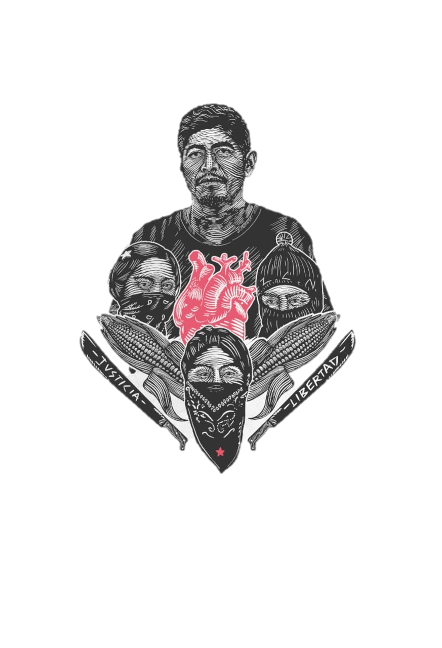
Danay Kiskyra [trans. Colectiva Amplificadora]
Translation of this article from Greek: https://www.efsyn.gr/ellada/koinonia/501830_i-koinoniki-katoikia-einai-edo
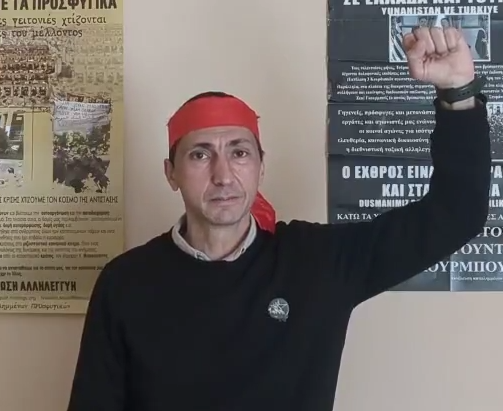
WE WILL WIN, OR WE WILL WIN
The Attica Region’s program for the redevelopment and “return to society” of 108 of the 228 apartments in the Prosfigika buildings on Alexandras Avenue, an urban complex built in the 1930s, does not do justice to the example set by the community that began to develop around 2011 and is breathing new life into what was once an abandoned area.
●
What will become of the 250 members of the self-organized community and its structures, the owners and tenants of the remaining apartments?
●
Aristotelis Xantzis has begun a hunger strike to the death.
●
“We have no choice but to win,” say the residents.
With its familiar rhetoric of “return to society,” the Region of Attica is attempting to immediately launch—within the first quarter of 2026—the first phase of its plan to intervene in the Prosfygika buildings on Alexandras Avenue, announcing competition for four of the eight historic apartment buildings. The €15 million project, which is part of the 2021-2027 Regional ESPA, provides for the renovation and restoration of the facades of the buildings and 108 apartments by 2028.
Behind the announcements, however, critical questions remain, because among the 228 apartments in the complex, 177 have already been transferred to the Region, 51 still belong to private individuals, and the possibility of new expropriations has not been ruled out.
The structures
The eight apartment buildings, with a total area of 17,215 square meters, have been designated as preserved monuments by decisions of the Council of State in 2003 and 2009, as they are among the few surviving social housing complexes from the interwar period. They are therefore not “inactive properties” but a historic urban complex of great importance to the city.
The Region states that the 108 apartments will be used for “social housing” and to accommodate companions of patients at the Agios Savvas cancer hospital. The official narrative speaks of “redevelopment” and “protection of cultural heritage.” However, the reality inside the buildings belies the image of abandonment that is being systematically cultivated.
The Prosfygika buildings are not dilapidated structures; they are structures that have withstood the major earthquakes in Athens for almost a century thanks to the quality of their original construction and the constant care of their residents, and they bear historical marks from the bullets of December [1944]. More than 400 people, from 27 nationalities, form a vibrant social fabric in the city center. For them, the “restoration” plan translates into violent eviction and displacement.
Targeting the neighborhood as a “hotbed of lawlessness” serves as an ideological excuse, since, in practice, at Prosfygika assemblies function as well as health, hospitality, cultural, and solidarity structures. Drug trafficking, often used as a scare tactic by government officials, has been addressed since 2010 through collective decisions and a clear ban within the community. On the contrary, the only systematic aggression that has been reported is the repeated police operations using chemical agents, right next to hospitals and residences with children and elderly people.
The state proclaims that it seeks to create social housing, overlooking the fact that Prosfygika already serves as social housing for vulnerable people, such as the elderly, the sick, the homeless, refugees, and single-parent families. Today, behind the 15 million-euro “restoration” announced by the government, many still see a process of gentrification that will drive up the cost of living in the Ampelokipoi area. Particular emphasis is placed on creating facilities for patients’ companions from neighboring hospitals, but such structures operate already on the initiative of residents, while dozens of public and church properties remain unused, at a time of systematic deterioration of the ESY (National Health System).
Reproduction of life
At the heart of the neighborhood is the Children’s Hangout and Self-Education Center, along with the Self-Organized Kindergarten, which offers a daily educational program and collaborates with schools and parent associations. The Social Center hosts the general assembly and a number of political and cultural events, while the Library, the Self-Education Group, and the Cinema are permanent spaces for knowledge and culture. The Artistic Group organizes theatrical and musical projects, providing a public platform for expression.
In the sphere of daily reproduction of life, there is a Food Distribution Structure, a Clothing Structure, a Storage Structure (with furniture and household items), as well as a Skipping Structure, which collects products from street markets. The self-organized “Berkin Elvan”1 bakery produces bread daily, while the Collective Cafe Structure is a regular meeting place. At the same time, the Homeless Solidarity Group uses the community’s infrastructure to feed dozens of people in the center of Athens.
In the field of health and social care, the Health and Social Pharmacy Structure operates in collaboration with social clinics and health associations. The Accommodation Structure for patients and companions of the Agios Savvas cancer hospital covers needs that the state leaves uncovered. There is also an Animal Structure for the care of stray animals in the area.
Gender and social empowerment structures play an important role: the Women’s Structure, which offers support and emergency accommodation, and the Men’s Political Education Group on gender issues, which seeks to open up public debate on patriarchal structures. The Youth Structure encourages younger members to participate in social struggles.
The material and technical infrastructure is supported by the Internet Structure, the Technical Works Structure (which maintains and renovates the buildings), and the Legal Affairs Team, which handles documentation and rights issues. At the same time, the International Solidarity Structure, with two host houses, as well as the Hosting Structure of the “Borderless” collective, house refugees, migrants, and solidarity activists from other countries. The Banner Team and the Gymnastics Team strengthen the public presence and collective cohesion of the community.
With their own resources
This entire network operates without state funding, relying on self-organization and collective responsibility. The residents of the Community of Squatted Prosfygika themselves say they are determined to defend the space and that they have no other choice. “Either we will win or we will win,” as they say, while one of their members, Aristotelis Xantzis, has gone on hunger strike “to the death in defense of life.”
Prosfygika is not a “problem to be managed,” but a living example of social self-organization and solidarity, especially at a time when social housing in Greece remains virtually non-existent. So, the question that arises is not whether the Prosfygika buildings will “return to society,” as the government claims, but whether the state is willing to recognize the society that already exists within them.
“An example of self-management, autonomy, and collective organization”
Tasis Papaioannou, Architect, professor emeritus at the School of Architecture, Athens National Polytechnic University
At a time when housing has been transformed from a social right into an expensive commercial product, the Prosfygika project reminds us that there can be another way of living and collective organization.
The possibility that at some point the state authorities, and specifically the Region of Attica, would proceed with the eviction of Prosfygika has always existed. The pretext is to repair the buildings and turn them into social housing: three apartment buildings, according to press reports, for social housing, and one for accommodating patients’ companions at the Agios Savvas hospital.
In my opinion, this is a specious justification, given that social housing, in its most essential form, is exactly what is currently happening at Prosfygika. This is, in practice, the definition of social housing. If one also takes into account the relocation of the Alexandras Avenue stadium to Votanikos, as well as the planned wider redevelopment of the area—an extremely central zone of the city, often described as a “prime location” – it becomes clear that different development scenarios are taking shape.
It is well known that the apartment buildings have been listed as protected buildings since 2009, so demolition is not an option. The crucial question, therefore, is not whether they will be restored, but under what conditions this restoration will take place. Preserving architectural heritage is not just about the shells of buildings, but also about the life that develops within them. Buildings without their people are, in fact, dead.
Another factor that I consider important is that a lived-in space is one that stands the test of time. If the apartment buildings had not been inhabited all these years and had not been maintained, even with limited means, by their occupants, their current condition would clearly be worse. Despite the fact that they were built between 1933 and 1935, they have not suffered serious damage in terms of their structural integrity. The damage is mainly limited to plasterwork and oxidation of the reinforcement on the balconies, which are maintenance issues rather than critical structural problems.
These apartment buildings are a symbol of the city’s historical memory. They still bear traces of the December battles, elements that must be preserved so that the historical experience imprinted on them is not erased. They constitute an important monument of modern architecture, both as individual buildings and as a unified urban complex of eight apartment buildings. At the same time, they serve as a reminder of the refugees’ ongoing struggle for decent living conditions, an experience that remains relevant today.
At present, Prosfygika is, in my opinion, an example of self-management, autonomy, and collective organization. They function as a living enclave of social solidarity, open to the neighborhood. The structures that have been created—such as the communal bakery and kitchen—are not only for residents, but also for people from the wider area, including the homeless.
At a time when housing has been transformed from a social right into an expensive commercial product, this project reminds us that there can be another way of living and collective organization. The restoration of the buildings must be carried out with respect for both historical memory and the people who keep them alive today.
“We will not cede an inch of ground to the regime.”
Community of Squatted Prosfygika
Today, more than 400 people live in Prosfygika, including Greeks, refugees, and immigrants, 50 minors, vulnerable social groups such as people with serious mental health problems, cancer patients, the elderly, and others. In its 16 years of operation, the Community has removed the drug manufacturing and trafficking spots that with the tolerance of the Greek Police plagued the neighborhood, and [the Community] has established 22 autonomous structures of social self-sufficiency, benefit, and self-organization for the people of Prosfygika and of the areas of Ampelokipoi and Gyzi.
Within the last year, the Community has publicly announced its decision to renovate the exterior of the Prosfygika buildings with its own funding and with the participation of architects, civil engineers, and other technical specialists.
The Region’s decision is a central political initiative of the Mitsotakis regime to dismantle the largest social project in Greece and one of the largest in Europe, which has attracted interest in Greece and abroad, from universities and cultural and educational institutions. For the regime, Prosfygika is a political opponent it seeks to destroy and an economic prize it dreams of exploiting, selling social sensitivity and “law and order.”
They are lying when they claim that the Region cares about social housing, the relatives of cancer patients, social problems, and the utilization of the Prosfygika buildings. Prosfygika already provides social housing for hundreds of people. Prosfygika already offers cancer patients and their relatives decent living conditions. Prosfygika is an example of the harmonious coexistence of 27 different nationalities and corresponding languages and religions. It is the only neighborhood located next to an OKANA2 unit where there is simultaneously a square with no drug dealing.
The redevelopment of the Prosfygika buildings will cause rents and living costs to skyrocket throughout the area and force dozens of our neighbors who cannot afford the high costs to leave, gradually affecting all neighboring areas. For our part, we have a responsibility and a duty to defend our lives, keeping alive a neighborhood and a social model that the state wants to destroy in order to profit from its redevelopment.
The people of our community and their families, who will find themselves sleeping in cardboard boxes. The mental and physical health of dozens of children, elderly people, and patients. Many of the latter are under the care of the Community, and next year, when the eviction takes place, they will no longer be alive, and the government will be responsible. We will not give an inch of ground to the regime and its companies. We will fight with all our power to cancel their dirty plans, even with our lives.
“They do essential work in the neighborhood.”
Evi Salta, employee at Agios Savvas Hospital, member of the Scientific Council and elected representative of the Employees’ Association
My first contact with the structure operating in the Prosfygika buildings on Alexandras Avenue was a few years ago, through the people who organized it and support it exclusively with their own resources. It is an autonomous, self-funded initiative that has done substantial work in the neighborhood. One of the most important aspects of their presence is that they have contributed significantly to the removal of drug dealers from the area. In a densely populated neighborhood with schools, children, and teenagers, this is particularly important and, in my opinion, a significant contribution.
At the same time, they offer shelter and protection to vulnerable people and families from various countries. Last summer, I had the opportunity to meet young people participating in the project from France, Belgium, Germany, and the Netherlands, which demonstrates the existence of a broader, pan-European solidarity network. Based on this logic, they have developed partnerships with doctors, nurses, and educators, offering information and support, from first aid to educational activities.
I consider it particularly important that they have created, at their own expense and through their own efforts, an apartment that can accommodate two patients and their companions at the same time. They asked for our cooperation in this initiative. The apartment is fully equipped and has already hosted patients from Agios Savvas Hospital. As an example, I would like to mention the case of Mrs. Despina from Tripoli3, who underwent surgery at the hospital and is scheduled to undergo approximately 30 radiotherapy sessions. As she does not have the financial resources for a long stay in Athens, she is being accommodated there for a period exceeding one month, thus avoiding unbearable costs.
It is a self-organized collective. The level of organization is high, the space is clean, and it has heating, a washing machine, a kitchen, and basic necessities for the first few days of stay. We are in talks to make this option known to the hospital’s social services department so that patients in need can be accommodated at no financial cost. A second patient from Arta is already expected for radiotherapy, and a second apartment is being prepared.
There are, of course, accommodation facilities associated with Agios Savvas, such as “PNOI” and “Galileia,” but a small fee is required. However, demand is so high that the available spaces are usually full. The need for free accommodation for patients who travel from the provinces for treatment is real and constantly growing.
At the same time, the Region has announced a plan to remove people living in Prosfygika, as part of a project budgeted at around €15 million. The residents themselves are asking for this money to be given to the hospital to hire more staff, given the understaffing that has been acknowledged in official government announcements.
Mobilizations, including hunger strikes, have already begun by people living in the area who fear they will be evicted without any indication of where they will go. For many of them, Prosfygika is their only stable point of reference, a framework within which they have begun to rebuild their lives. In a modern European country, social welfare must take precedence over repression and guarantee that no one will be returned to complete insecurity.
“I never felt alone”
Despina Michalopoulou, patient staying at the structure
“People ask me every day if I’m okay or if I need anything. Even a primary school kid stopped me to offer me food,” says Despoina Michalopoulou.
I am from Tripoli and am currently staying at the Prosfygika accommodation facility, as I am undergoing daily radiotherapy and will need to remain in Athens for about a month and a half, except for weekends.
I found out about the facility by chance. From my hospital room, where I was recovering from my operation, I saw a sign saying that it was a shelter. I looked for information, found an email address, and sent a message. The response was immediate, and within a very short time, my accommodation had been arranged.
The space is clean, well-maintained, and fully equipped. It has a kitchen and everything I need, which allows me to cover my daily needs without incurring dining expenses. There is the possibility of hosting a companion so that I am not alone. The people here are extremely kind and willing to help with anything I need. From the very first moment, I felt comfortable and safe, as if I were at home.
For me, constantly traveling to and from Tripoli would be extremely expensive and particularly tiring, especially at a time when my stamina is not what it used to be. Part of the expenses are reimbursed, but with a long delay, which makes it difficult to manage my needs immediately. At another facility I contacted, the cost was €10 per day. The amount may seem small, but for a month and a half it amounts to about €450-500 – a significant burden for a family like mine.
I am currently unemployed, my husband works as a builder, and our daughter is taking her national exams. Our finances are already under pressure. Accommodation here is provided free of charge. In fact, the apartment was stocked with basic goods, food, coffee, water, and even essential items to cover the initial expenses of someone who may not have even the bare necessities. This care is deeply moving. What impressed me most was the atmosphere of solidarity. Although I am far from home and alone most days, I never felt isolated. People ask me every day if I am okay or if I need anything. Even a primary school child stopped me to ask my name and if I was hungry, offering me food. This spontaneous care and sense of community is rare, even in smaller towns.
I am aware that interventions are being planned that may lead to the removal of the people who live and work here. As someone who has experienced the hospitality of this community, I believe that this project is an example of harmonious coexistence and mutual support between people of different backgrounds and experiences. In my opinion, such initiatives should be encouraged and promoted, not disparaged.
Personally, I feel deeply grateful. It would be difficult for me to find a place where I feel so welcome, safe, and truly cared for. During a demanding and vulnerable period of my life, this support has been crucial.
1[Berkin Elvan was a 15-year old Kurdish boy killed by a tear-gas canister that police shot into his face during the 2013 Gezi Park protests. He died in 2014 after a 9-month coma.]
2[Stands for oργανισμός κατά των ναρκοτικών — “institution against drugs”, an initiative of the Greek State.]
3[City in Greece.]